
Editorial status: exploratory draft. This article discusses questions a future evidence framework could consider; it does not describe a live Swachhta audit, certification, or guarantee.
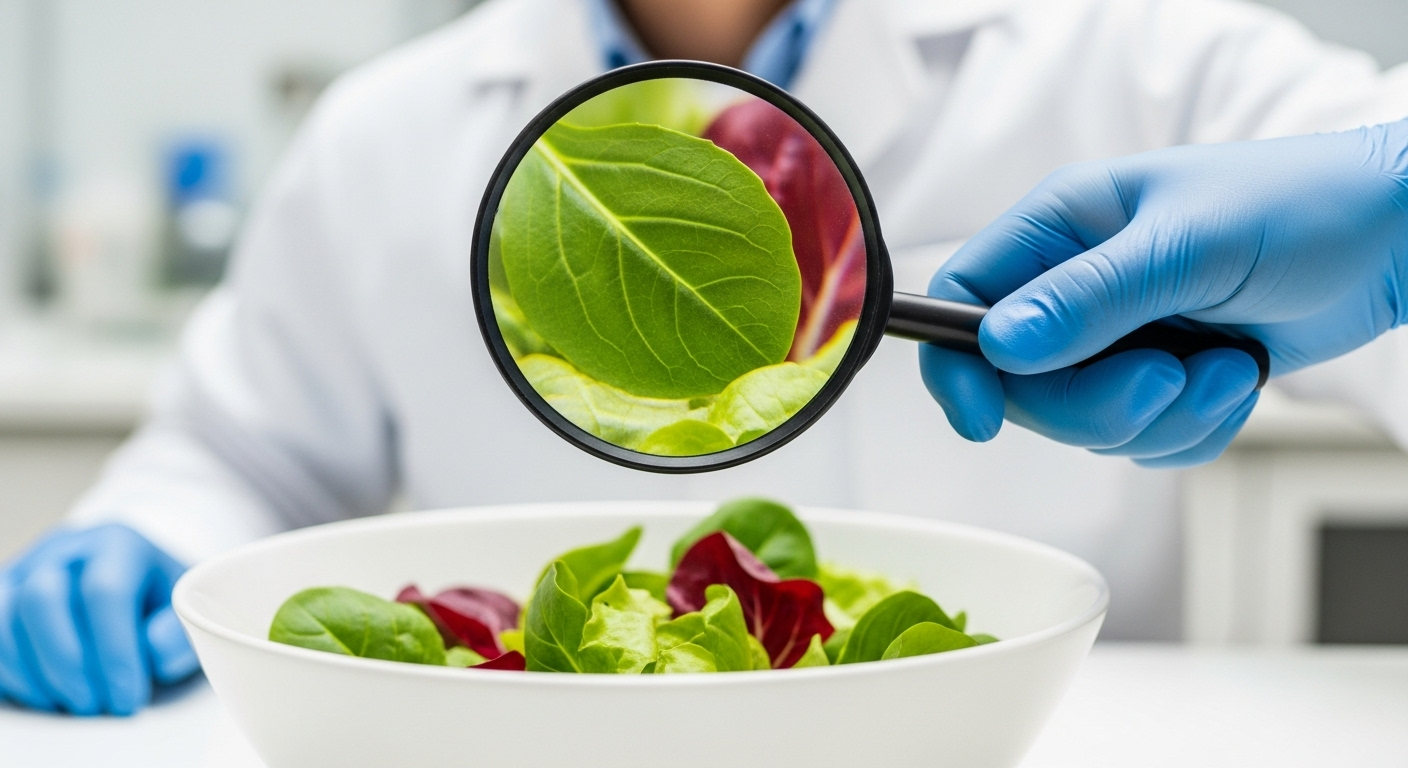
We’ve all been there. Choosing the salad, the fresh-pressed juice, or the raw vegetable sandwich because it’s the “healthy option.” We trust that the vibrant colors and crisp textures are a sign of purity. But what if that visual freshness is hiding a microbial truth?
Raw foods are the frontline in the battle for consumer health, and it’s here that the “Confidence Gap” is widest. Unlike a cooked dish where heat can eliminate many pathogens, a salad’s safety depends on a chain of trust that is almost entirely invisible to the consumer. This article investigates that chain.
The Journey of a Lettuce Leaf: Where Purity Fails
The journey from farm to fork is fraught with invisible risks. A single contaminated ingredient can compromise an entire dish. Here are the three most critical failure points:
1. Contamination at the Source
The process begins in the field. The safety of a simple lettuce leaf is determined by factors we never consider:
- Water Quality: Was the irrigation water free from harmful bacteria like E. coli?
- Soil Health: Was the soil contaminated by runoff from nearby animal farms?
- Harvesting Practices: Were the harvesting tools and workers’ hands sanitized properly?
A failure at this first step means the contamination is literally “baked in” before the ingredient ever reaches a kitchen.
2. The Cold Chain: A Race Against Time
Microbes multiply rapidly at room temperature. To keep raw vegetables safe, they must be kept in an uninterrupted “cold chain”—a consistent, cool temperature from the farm, to the truck, to the restaurant’s refrigerator. A single hour in a hot loading dock or a faulty refrigerator can allow bacteria to grow to dangerous levels, even on produce that still looks perfectly fresh.
3. Cross-Contamination: The Kitchen’s Unseen Threat
This is the most common and dangerous failure point. A busy kitchen is a minefield of potential cross-contamination.
- The same knife used to trim raw chicken is then used to chop tomatoes for your salad.
- The same chopping board, given a quick, inadequate rinse, transfers pathogens.
- The water used to “crisp up” the lettuce is from a tap that hasn’t been properly maintained.
These small, unseen moments of contact are how a healthy meal becomes a source of foodborne illness.
A future evidence framework
Blind faith is not a useful product strategy, but a label is not proof by itself either. A future Swachhta framework could make questions, evidence, and limitations visible. For raw foods, a design discussion might include:
- Sourcing context: What supplier, water, and traceability records exist, and what are their dates and limitations?
- Temperature records: What parts of the cold chain are measured, how is the device or method validated, and what happens when a reading is missing?
- Cross-contamination controls: Which workflow controls are documented, observed, and attributed to a responsible operator?
- Water evidence: Which tests or public-health references apply to the location, and who reviewed the result?
What You Can Do as a Consumer
Empowerment begins with knowledge.
- Ask Questions: Ask a restaurant if they have separate preparation areas for raw and cooked foods.
- Treat labels as a starting point: A future public profile should explain what was checked, when, by whom, and what was not covered. No seal or label should be treated as a universal guarantee.
- At-Home Safety: Apply the same principles in your own kitchen. Use separate chopping boards, wash hands thoroughly, and store raw meats below fresh produce in your refrigerator.
The choice to eat healthy should never be a gamble. It is our mission to ensure that when you choose a fresh salad, you are choosing health in every sense of the word.